

A fascinating, luminous metal, believed by ancient peoples to possess divine qualities, and a strategic asset in the modern world for protecting capital against devaluation. Over the millennia, gold has altered its relationship with our species, yet never severed it. For over 6,000 years, humankind has scoured rivers and the earth in search of the noblest of metals, inventing ever-new techniques to locate, collect and work it.
And that brings us to today’s question: how much metal remains in the veins of our planet?
Gold, as we know, is a finite resource that cannot be imitated, copied or artificially reproduced in a laboratory. Its origins are still a matter of debate, but there is no doubt that they are not of ‘terrestrial’ origin. The most widely accepted hypothesis, particularly following a study conducted in 2017, suggests a collision between two neutron stars: the collapsed cores of stars so dense that a single teaspoon of the material they are made of would weigh, on Earth, up to a billion tonnes. The enormous density of neutrons resulting from the collision between these celestial giants would be such as to create gold, platinum and other heavy elements. However, these phenomena would have occurred too late in cosmic history to explain the formation of gold in the earliest eras of the universe.
A second theory suggests that gold originates in the cores of supernovae, which act as forges for various heavy metals – including gold. However, stars of such immense magnitude that this process is possible are exceptionally rare: the few that do exist are so massive that, upon their death, they turn into black holes – which would inevitably end up swallowing the gold.
Whatever the origin of this precious substance, these immense celestial bodies would have scattered it throughout the universe in the form of debris, which would then have coalesced to form the planets. The Earth is therefore presumably rich in gold in its core and innermost layers, but thanks to seismic and volcanic activity and meteorite impacts – which themselves contain varying amounts of the yellow metal – the planet’s surface also contains it. And this is the only gold we can hope to obtain.
Let’s take a look at the image below:
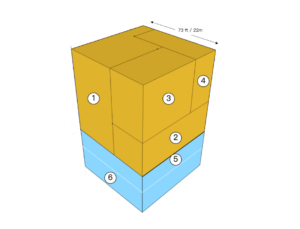
The most accurate estimates of the total amount of gold mined throughout history put the figure at 219,890 tonnes, around two-thirds of which has been mined since 1950.
If every single gram of gold ever mined were placed side by side, the resulting cube would measure just 22 metres on each side: an extremely small volume for such a precious and sought-after metal, with such an ancient history. Given that gold is virtually indestructible, we must assume that all the gold mined to date still exists in some form.
Since the 2000s, we have seen a decline in available resources, due to the scarcity of newly discovered deposits. Current reserves are estimated at around three billion ounces, which, at current rates, would be sufficient to sustain approximately 25 years of production. Within these resources, it is worth making three further distinctions:
- Recoverable reserves, still present underground
- Geologically identified reserves, the economic viability of which is currently being assessed
- A marginal portion of past production, already extracted, representing a negligible fraction of the total
Compounding the situation is a sharp decline in investment in mineral exploration, with the sector’s budget set to fall by 15% in 2023 and a further 7% in 2024 – despite the rise in the price of gold.
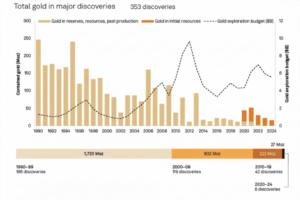
The chart, which shows the annual analysis by S&P Global Community, indicates that between 1990 and 2024, 353 deposits were identified containing (approximately) 3 billion ounces of available reserves, geologically identified reserves and residues from past production. The total increase would amount to 3% and would be equal to 82 million ounces – the previous analysis conducted in 2024 identified 350 deposits, containing 2.89 billion ounces of gold.
How does mining capacity affect the price of gold? Over the last twenty years, this safe-haven asset has shown a negative correlation with the rate of new discoveries. It should be borne in mind that it takes around ten years to bring a mine into operation. For this reason, the scarcity of newly identified deposits may have contributed to the rise in the price of the precious metal.
As it is not possible to tap into new sites, the focus is on expanding existing ones. In 2024, 80% of exploration expenditure was allocated to mines already in operation: indeed, even countries that have historically been at the forefront of identifying gold deposits, such as the United States and Canada, are experiencing a drastic reduction in their ability to open up new frontiers. For its part, China has already turned its attention to exploring new regions, but despite significant domestic production, it remains essentially a net importer of gold.
Despite the sharp rise in the price of gold, mining companies do not currently appear willing to increase their budgets for exploring new deposits.
The costs of exploring, extracting and bringing a mining site into production continue to discourage exploration – not to mention increasingly stringent regulations, the energy crisis and inflationary pressures.
The mines are currently operating in a context of relative stability between supply and demand, but if the trend of recent years were to continue, it would inevitably end up altering the very structure of supply: at present, in fact, the gold market is operating at a rate of almost 5,000 tonnes of metal per year.
Sources: