


There seemed to be a glimmer of peace in the Middle East, but after just twenty days of truce, tensions between the two powers have flared up again.
The renewed tensions around the Strait of Hormuz threaten to paralyse a fifth of the world’s crude oil trade, which has gained +4% following the latest news.
Stock markets wake up deep in the red, and gold slips on fears of inflation and fresh monetary tightening. It is a period of sharp contradictions for the safe-haven market: on one hand it benefits from the disappointing figures in the US employment report (new jobs were half of what was expected, with the unemployment rate stable), while on the other it is weighed down by the recent Fed minutes, in which the focus on inflationary risks remains palpable. The US central bank appears determined to maintain a restrictive monetary policy, effectively putting a brake on gold’s rally as it is discouraged by high real yields.
Hormuz and oil: why the price of gold remains under pressure
The Strait of Hormuz is currently still accessible to merchant ships, although the high risk of attacks discourages navigation through the chokepoint. Following the latest Iranian assaults on vessels, maritime authorities continue to recommend the route through the southern waters of Oman.
Oil has not yet reached the levels seen during the most intense phase of the conflict, but it still remains far from the price prior to the escalation. The spectre of inflation thus returns to stoke fear, with a twofold effect on gold: on one side the tension around Hormuz supports demand for safe-haven assets, while on the other high energy costs and expectations of persistent inflation make it less appealing.
Technical analysis: the key levels of the gold price
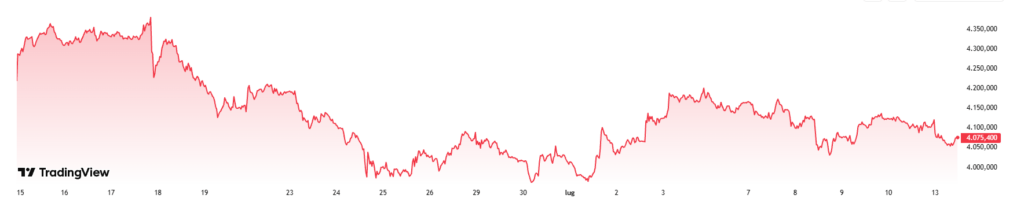
The chart shows gold’s fluctuating performance over the past month. From a technical standpoint, the bears retain the advantage in the short term, as the price continues to sit below the main resistance levels.
- Bullish scenario: the bulls are looking for a break above $4,138/oz; once that threshold is reclaimed, the path towards $4,203 would be clear, targeting the 50-day moving average at around $4,352;
- Bearish scenario: the bears are aiming to break the support at $4,021/oz, with subsequent targets at $3,942 and $3,886.
The role of central banks: gold still among the favoured assets
The surveys conducted last month by the World Gold Council reveal an interesting figure: “45% of central banks plan to increase their gold reserves over the next 12 months”; at the same time, the annual OMFIF survey clearly shows that they continue to regard gold as one of the favoured assets for portfolio diversification, especially in light of an increasingly uncertain global financial system.
But central banks are not limiting themselves to statements in support of gold: in May, they added 41 net tonnes of the metal to their official reserves. The multi-year trend of demand from financial institutions therefore continues, with many of them having ridden the corrective wave that hit gold in June.
Poland and China lead the buying
Among the most aggressive buyers stands out Poland, which in the first half of 2026 accumulated a hefty 82 tonnes: Adam Glapinski, governor of the Polish central bank, openly stated that he took advantage of the price drop to build up the country’s gold stockpile. In the Far East, China dominates the market, marking with June the 20th consecutive month of purchases and the largest monthly increase of this year: 15 tonnes added to its holdings.
Why central banks buy gold (and traders don’t)
The decisions of central banks stand in stark contrast to those of retail investors, who are busy chasing the momentum of the artificial intelligence stock market; others, as we have already seen in previous publications, have liquidated their gold positions to cope with rising energy costs.
But why do traders behave so differently from financial institutions?
The answer is that the latter do not ride the market’s momentum, nor do they measure risk in quarters, but rather in decades; in this way they prepare a tool of protection against possible geopolitical shocks and financial crises. They recognise in gold the characteristics that have always made it one of the benchmark safe-haven assets: it is universally accepted, liquid, free of counterparty risk and independent of any fiscal or monetary policy. A far-sighted and prudent attitude that often contrasts with the logic of investors, who are more focused on short-term market movements.
Sources:
https://www.ilsole24ore.com/art/trump-all-iran-la-tregua-e-finita-siete-feccia-presto-colpiremo-nuovo-AJznunC
https://www.kitco.com/news/article/2026-07-10/gold-holds-above-4100-hormuz-tension-yields-pressure-silver-kitco-pm-report
https://www.kitco.com/news/article/2026-07-10/central-banks-are-voting-gold-their-balance-sheets