


For many investors, it is almost a given: gold shines brightest in times of crisis. But this is not always the case. The falls in the price of gold following the outbreak of the conflict between the United States and Iran have sparked fears of a correction, attributable to the rise in the cost of energy commodities priced in dollars (for further details, please see the article: Gold: what’s happening in the market and how is the conflict affecting the price?)
The fundamentals underpinning the price of gold remain unchanged, however, albeit spread over a much longer timeframe than 3–5 years – a period during which the safe-haven asset tends to be driven by financial rather than geopolitical factors.
The United States has accumulated a public debt of $38 trillion and an annual deficit of around $1.9 trillion, with interest payments on the debt amounting to $1.9 trillion a year. Faced with these figures, the US Federal Reserve (Fed) finds itself unable to raise interest rates aggressively without triggering a debt servicing crisis.
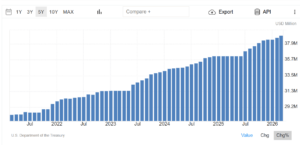
(The growth of US public debt over the last five years, source of the chart: https://it.tradingeconomics.com/united-states/government-debt)
After all, today’s geopolitical crisis has a historical parallel. The Arab oil embargo of 1973–74 followed a similar pattern: the energy shock triggered a surge in inflation, the Fed took no action, and gold underperformed against the backdrop of war and inflation. All this continued until the collapse of the interest rate regime, when the US Federal Reserve was no longer able to keep real interest rates high enough to control inflation; at that point, gold rose sharply. There is, however, one key difference that sets the 1970s scenario apart from today’s: the United States was not running an annual deficit of $1.9 trillion at that time.
According to Bernard Dahdah, an analyst at the French investment bank Natixis, the fall in oil prices will pave the way for the Fed to cut interest rates, giving a boost to safe-haven assets.
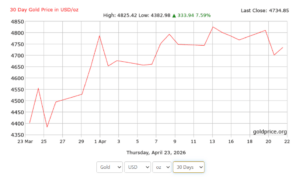
(Gold prices over the last 30 days, source of the chart: https://goldprice.org/it)
Following the ceasefire granted by Trump, gold has recovered by almost 1%, climbing back above $4,700 an ounce; conversely, the easing of tensions has caused oil prices to slip. The main source of pressure on gold, however, is not the conflict in the Middle East, but Washington. From the statements made by Kevin Warsh, a candidate for the chairmanship of the Federal Reserve, it is possible to discern a restrictive monetary policy: according to Warsh, no promises have been made to the White House regarding interest rate cuts.
The prospect that interest rates will remain unchanged in the second half of the year has reduced the appeal of gold, which pays neither interest nor dividends, bringing assets capable of generating a return into the spotlight.
The precious metal’s future movements depend on diplomatic factors – a tangible resumption of talks between the US and Iran could drive down oil prices and ease inflationary pressures, benefiting gold, although it must be borne in mind that a scenario of greater stability could reduce demand for safe-haven assets – as well as on economic factors. The rise in weekly claims for unemployment benefits could influence expectations regarding rate cuts by the Fed, and the dollar consequently.
Analysts continue to forecast a price range of between $4,000 and $6,300 for 2026: a year of consolidation, if we wish to call it that, following a rise of over 40% in the last 12 months.
Sources: