

After reaching 50 new all-time highs and yielding 60% in twelve months, gold confirmed its position as one of the best-performing assets of 2025.
Although the ultimate safe haven asset is known for its defensive stance, tending to be immune to sudden rises or falls, in recent months it has behaved similarly to a stock.
This speaks volumes about the current geopolitical landscape, where uncertainty reigns supreme and markets are reeling under the weight of economic turmoil.
2025: a “golden” performance
Last year, gold experienced an extraordinary rally: according to Gold Outlook 2026 and the World Gold Council, this was the fourth-best annual return since 1971.
The weakness of the dollar, the uncertain geo-economic context, ongoing conflicts, and new winds of war have inflated the sails of safe-haven assets, attracting the interest of investors.
Among the reasons for the rise, we must also mention the accommodative monetary policy of the Federal Reserve (Fed), the US central bank, which has reduced interest rates.
Historically, lower interest rates cause the price of gold to rise, as they reduce the value of money and make interest-bearing investments (such as government bonds) less competitive.
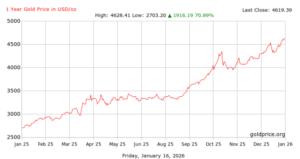
The chart above, which tracks the performance of the safe-haven asset from January 2025 to January 2026, clearly shows the upward trend that gold has experienced over the course of the year.
In the third quarter of 2025, demand for gold (ETFs, futures, bullion, and coins) from investors and central banks totaled approximately 980 tons: more than 50% higher than the average for the previous four quarters. This increase is made even more striking by the recent rise in prices, as 950 tons correspond to a quarterly value of approximately $109 billion—calculating an average price per ounce of $3,458, this represents an increase of approximately 90% compared to the average of the previous four quarters.
What are the prospects for 2026?
The geopolitical turmoil that shook 2025 has carried over into the new year, which looks set to be just as susceptible to global uncertainty. If current conditions persist, gold could remain largely stable; however, in the event of an economic slowdown and further interest rate cuts, the price of gold could continue to rise.
2026 will be the year when the results of Trump‘s tariff policy will be seen – if import taxes have the desired effect of strengthening the greenback, gold could come under downward pressure.
Purchases by central banks and investors will continue to play a key role in the performance of this safe-haven asset, which provides stability in periods of heightened market volatility. According to JP Morgan Global Research forecasts, demand from banks and investors is expected to average around 585 tons per quarter.
Credit institutions should reduce purchases to around 755 tons—in the last three years, they had peaked at over 1,000 tons—because, given the price above $4,000, they do not need to purchase as much raw material to bring the share of gold in reserves to the desired percentage.
Investment flows, on the other hand, are expected to remain solid, with ETF demand reaching 250 tons. The need for physical gold as a safe haven is growing, with bullion and coins set to exceed the already high threshold of 1,200 tons of annual demand.
Investors’ positioning on futures remains long, i.e., oriented toward price increases over time.
Natasha Kaneva, head of global commodities strategy at JP Morgan, said that the trends driving the price of gold higher are not yet exhausted.
The trend toward diversification of official reserves and investments is projected to continue over the long term, and demand for gold could push prices toward $5,000 per ounce by the end of 2026.
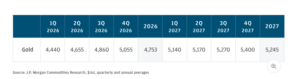
The chart above shows the forecasts of JP Morgan Global Research, which assumes an average of $5,055 per ounce in the fourth quarter of 2026.
By the end of 2027, the price is expected to reach $5,400 per ounce. What is certain is that if just 0.5% of US assets chose gold as a diversification strategy, the price would skyrocket to $6,000 per ounce.
Considering that mining supply is at a standstill, slow to react to the increase in the cost of raw materials, there is a real risk of not being able to meet demand. JP Morgan analysts’ forecasts are, by their own admission, conservative.
Sources
Gold Outlook 2026: Push ahead or pull back
A new high? | Gold price predictions from J.P. Morgan Global Research
Oro record oltre i 4.600 dollari: l’outlook sul 2026 | We Wealth