

It has been a tough morning for the ultimate safe-haven asset, which kicked off the week with a dramatic plunge. The loss is in double figures: down 14.9% over seven days, dipping today to just above the $4,152 per ounce mark (around €115.47 per gram). The yellow metal’s slump has now been ongoing for a full four weeks.
Nei prossimi paragrafi cercheremo di individuare le cause dietro l’incertezza dell’oro, che dopo le recenti performance stellari sembra tornare “coi piedi per terra”.
The conflict in the Middle East: the risk of inflation looms large
The main reason behind the decline in the value of safe-haven assets lies in the Middle East, which has been ravaged by the bombings of the recent conflict. Despite the positive signals announced by Trump regarding US-Iran talks, fears of rising inflation are driving major economies to seek liquidity – energy, rather than precious metals. Demand for safe-haven assets is slowing, with investors attempting to offset other losses within their portfolios. This is why gold is becoming the ideal hedge against capital losses accumulated on shares and bonds.
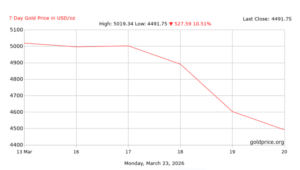
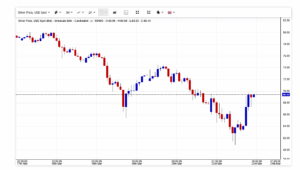
Even silver has not been spared from the energy crisis panic: in the space of a week, the white metal has fallen by around 19.8%. The charts below show the performance of gold and silver over the last few days, from 13 and 17 March respectively:
Interest rates unchanged by the Fed and the ECB
The central banks of the United States and Europe are also holding gold back by keeping interest rates unchanged. It is now almost a foregone conclusion that high energy prices will eventually drive up inflation: a prospect that is enough to dash any hopes of an interest rate cut by the major central banks.
In a scenario of rapidly rising living costs, central banks tend not to cut interest rates, thereby encouraging the public to save and cut back on spending. Assets that do not generate additional annual income – including gold – therefore tend to lose their appeal to investors.
The mid-morning rally following the truce announced by Trump
After a disastrous start, a turnaround. Around midday, the US President announced the prospect of a truce with Tehran: a five-day halt to all military attacks on Iranian power stations and energy infrastructure.
Gold and silver staged a modest recovery, posting gains of 3.44% and 6.71% respectively.
This morning, gold had wiped out all the gains it had made since the start of the year (-8.4%); the same was true of silver, which had lost 10.7% in a single day.
Has gold lost its lustre?
For the ultimate safe-haven asset, 2025 was a record-breaking year. It gained nearly 70% over twelve months, paving the way for a much-needed period of consolidation. Analysts had predicted a trading range of between $4,500 and $5,500 for 2026. After all, in a market constantly shaken by conflicts and macroeconomic crises, the least investors can expect is widespread volatility.
If central banks’ fears prove to be well-founded and inflation starts to rise again, real interest rates would likely be pushed down, thereby supporting the price of precious metals. Periods of consolidation – such as the one we are currently experiencing – do not therefore represent a reversal of the trend, nor do they undermine the credibility of investing in physical gold. On the contrary, a natural period of consolidation could strengthen the role of gold as a safe-haven asset in the medium to long term.
Sources:
Repubblica_perchè il prezzo dell’oro sta crollando
Ansa_rimbalzano oro e argento dopo la tregua annunciata da Trump
Rai News_Ultimatum di Trump Hormuz