Gold is one of the most sought-after precious metals in the world, prized for its beauty, its rarity, but above all for its value. In everyday language, we sometimes use expressions such as “raw gold”, “pure gold” and “fine gold” without being fully aware of the differences between them. Let’s find out together where these definitions come from.

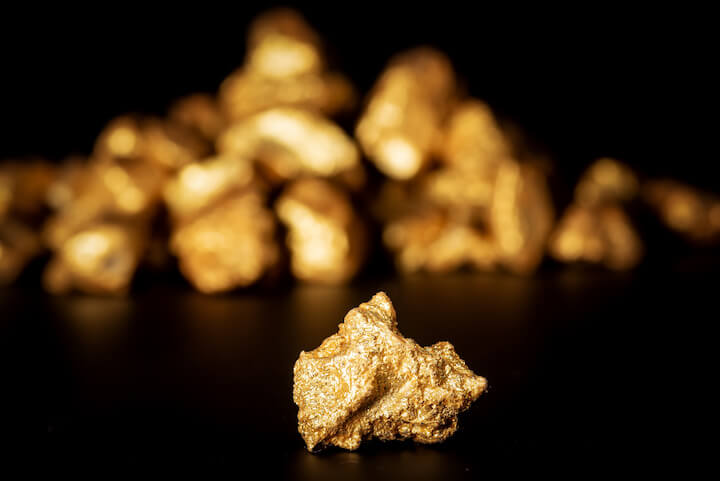
Raw gold – also called native gold – is gold that is extracted from the earth and has not undergone any processing. It is usually found in the form of nuggets or veins inside mines. Raw gold nuggets can vary in size: from small particles to boulders weighing several dozen kilograms.
Raw gold is found in various parts of the world, but some of the main production areas include Australia, Canada, the United States, Russia, South Africa and China. Most raw gold is extracted from underground or open-pit mines.
Its appearance can vary, particularly in colour, which depends on the impurities present in the material. Raw gold often contains other metals, such as silver, copper and platinum, or other substances such as silica or quartz, which affect its colour and texture.
Its composition in nature is therefore not perfectly pure, but has a variable percentage of impurities.
The value of raw gold depends on several factors, including its purity, size, shape and geographical location. In general, raw gold is less expensive than processed gold, as it still needs to undergo refining processes that significantly increase its value and make it suitable for processing into ingots, coins and jewellery.
The price of raw gold is determined by gold prices on the commodities market, which in turn is influenced by economic and political factors such as inflation, global demand and the geopolitical situation. In addition, the costs of extracting raw gold can vary depending on the location of the mine and the level of difficulty in extraction.
To recognise raw gold, it is important to bear in mind some of the typical characteristics of this metal in its natural form.
First of all, raw gold has a distinctive lustre, which is very different from that of other metals. It is very shiny, even if it has not yet undergone any kind of processing. In addition, raw gold has a bright yellow colour that does not change over time.
Still looking at its appearance, raw gold is characterised by a typically irregular shape and a rough, grainy texture, determined by the presence of impurities and other metals.
From a physical point of view, however, native gold has a very high density compared to other metals: this means that, when placed on a scale, it weighs more than similar objects made of other metals.
In any case, to recognise raw gold, it is important to rely on experts in the field, who can analyse it and verify its composition and origin.
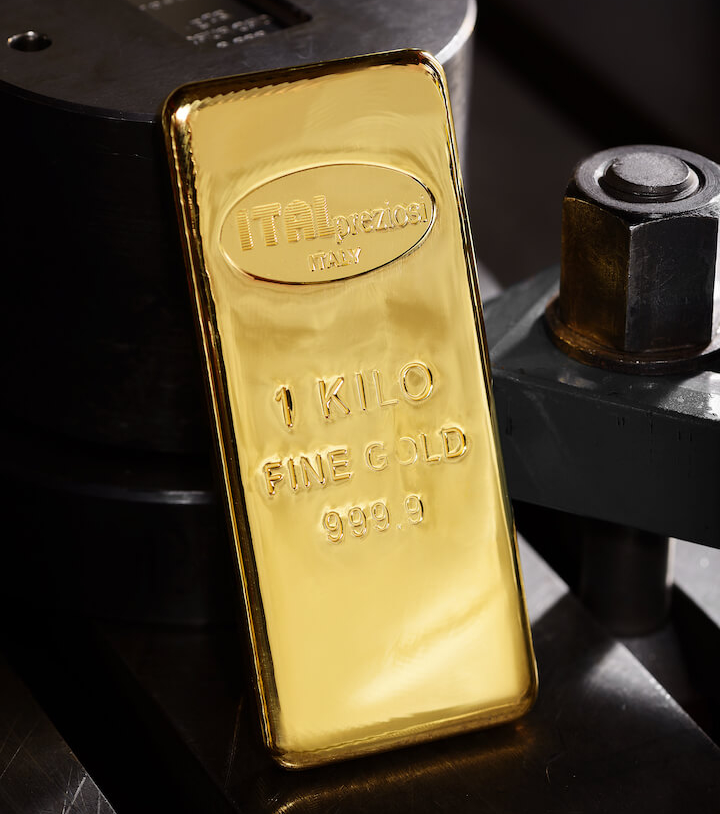
Pure gold, as the name suggests, is gold in its purest form. This type of gold consists of an alloy composed of 999.9 per thousand gold and 0.1‰ other substances. Its value corresponds to 24 carats, the highest level. It should be noted that thousandths and carats are the two units of measurement used to assess the purity of gold.
One of the distinctive characteristics of pure gold is its intense and uniform yellow colour, without variations or shades.
To achieve maximum purity, gold undergoes a very careful refining process: it is melted and separated from other substances present in its raw composition, such as silver, copper and platinum. This results in gold that is free of impurities and 999.9‰ pure.
One of the most appreciated characteristics of pure gold is its resistance to corrosion and oxidation, which makes it an ideal material for creating products that maintain their value over time.
Being particularly malleable, it is not suitable for jewellery production, for which 18-carat gold is normally used, an alloy that combines 75% pure gold with other metals that increase its hardness and resistance. This type of gold is usually better known as 750 gold, where purity is expressed using the thousandths system.

Pure gold is often used to produce bars, as it is a high-quality material with a constant value.
Gold bars are solid bars of precious metal, which can be purchased in various sizes and weights, depending on the buyer’s preferences.
The use of gold bars as an investment is widespread because it represents a stable and secure form of investment in the long term.
Gold bars are also used by central banks as a store of value and as a means of payment in situations of financial crisis and geopolitical uncertainty.
The price of pure gold per gram depends on various factors, including supply and demand on the world market, the quality and quantity of gold mined, and the global economic situation. You can always stay up to date and find out the cost of pure gold by checking the real-time gold prices.
We have all heard the expression ‘pure gold’ many times, but what does it actually mean?
In reality, there is no difference between pure gold and fine gold: in both cases, we are referring to the precious metal in its most valuable form, namely 24-carat gold, with a purity of 999.9 per thousand.
The value of zecchino gold is therefore the same as that of pure gold: its price is determined by the market price of the precious metal.
When the expression ‘oro zecchino’ is used, it is often to emphasise the aesthetic characteristics of the precious metal, and in particular its intense yellow colour, tending towards orange.
The origin of the expression dates back to the times of the Republic of Venice and the institution where coins were minted, the Zecca.
‘Zecchino‘ is the name given to the Venetian gold ducat in the mid-1500s: as a result of the preference given to freshly minted coins, the price of the new ducat increased, and in 1543 it was set at 7 lire and 12 soldi and christened “zecchino”.
The Venetian coin was then imitated by other Italian states in the following centuries, and many other currencies took the name “zecchino”: this term generally referred to coins of a higher quality than gold scudi and doppie.
This is where the expression ‘oro zecchino’ (pure gold) comes from, used to indicate extremely pure gold.
Nowadays, the same term is commonly used to emphasise the high quality of particular goldsmith products – such as pure gold leaf, also available in booklets – or household items, often made of ceramic, such as tea sets or “pure gold” dinner sets, or cutlery sets.
Regardless of how this expression is used, it is important to bear in mind that oro zecchino is no different from pure gold.