
GOLD quotation
Spot
(Eur/gr)
BID: 78,17
ASK: 78,31
(Usd/oz)
BID: 78,17
ASK: 78,31
SILVER quotation
Spot
(Eur/gr)
BID: 78,17
ASK: 78,31
(Usd/oz)
BID: 78,17
ASK: 78,31


Two different units of measurement are used to assess the purity of gold, and therefore its value: carats and thousandths. For this reason, for example, we can refer to 750 gold or 18-carat gold to indicate the gold commonly used in jewellery.
But what exactly do these measurements represent and what are the differences? Let’s find out together.
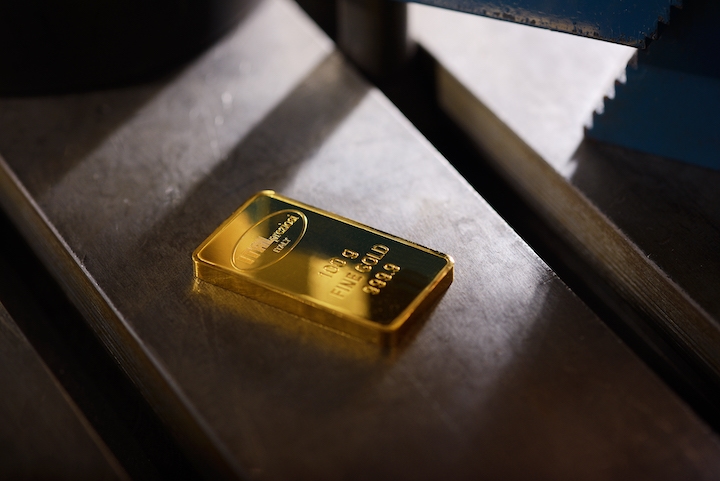
Gold fineness is the amount of pure metal relative to the total weight of the object. Law No. 46 of 1968 , on the Regulation of Fineness and Identification Marks for Precious Metals, establishes that gold, silver, platinum and palladium ‘must be stamped with the fineness in thousandths’.
The fineness of gold represents a measure of the purity of the precious metal expressed in parts per thousand.
At a regulatory level, therefore, the fineness of gold must be expressed in thousandths: for this reason, a pure gold ingot must be marked with the inscription 999.9, indicating a purity of 999.9/1000, the highest level achievable, as clearly stated in the technical data sheet of any pure gold ingot, such as, for example, the 100-gram gold ingot marketed by Italpreziosi.
According to this scale, it is easy to see that the well-known “750 gold” contains 750‰ of pure gold. However, not everyone will know that this corresponds to 18-carat gold, a term that refers to another unit of measurement for gold purity.
Carats, like thousandths, represent a measure of gold purity: what changes is the reference scale. One carat corresponds to 1/24 of a mass of pure gold: therefore, 24-carat gold – commonly referred to as ‘pure gold’ – has 24 parts out of 24 of gold and therefore a purity of 100%.
According to the same scale, as is easy to guess, 18-carat gold contains 18 parts of pure gold out of a total of 24, or 75%; the remaining 25%, as we have seen previously, is composed of an alloy of other metals.
The carat system is mainly used in jewellery: jewellery is usually made of 18-carat gold, which is less malleable and more resistant than 24-carat gold.
The origin of the term “carat” is particularly fascinating, with ancient roots: it derives from the Greek kerátion, which referred to the carob tree, itself a diminutive of keras, meaning “horn”, due to its shape. Carob seeds – literally “little horns” – were used to weigh precious objects. In fact, they were believed to always have the same mass, making them ideal as a unit of measurement.
The term was taken from the Arabic qīrāṭ, which literally means “twenty-fourth part”: in addition to being a unit of weight for precious metals, it was also a sub-multiple of the dirham, the silver coin used in the Islamic world during the Middle Ages.
Today, carats are used both as a unit of weight for precious stones and as an index of purity for gold alloys. In the latter context, the gold carat has retained its ancient value of 1/24, as in the Arab world.
It is a term with such an ancient and widespread meaning that today, by definition, the derivative “carat” is used to indicate the precise value of a person or a project.
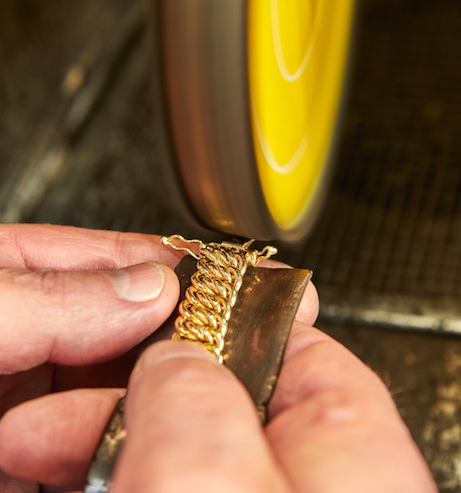
Whether it is yellow gold, white gold, rose gold or red gold, the precious metal par excellence must always have a mark recognising its value.
To understand the carats of gold, it is necessary to examine the hallmark on the product, whether it is jewellery, a bar or another gold object. The hallmark is a mark of recognition that identifies the manufacturer and the purity of the gold in the jewellery.
Alternatively, you can use a carat tester, a tool that allows you to determine the purity of gold accurately and reliably.
Once you have understood the carat weight, to determine the value in terms of cost, it is obviously pure gold (24 carats or 999.9 thousandths) that is used as a reference for the price, which is determined on the international markets by the London fixing twice a day.
To summarise what we have said, carats and thousandths both indicate the purity of gold, but on different scales.
The carat represents the fraction of 1/24 of pure gold in a precious object. Thousandths indicate the number of parts of pure gold per thousand.
So how many carats does 750 gold correspond to? This is one of the easiest examples, because it is perhaps the best known: 750 gold indicates an alloy containing 750‰ pure gold and the remaining 250‰ other metals. This value corresponds exactly to the 18 carat gold we mentioned earlier.
It is possible to quickly convert between the two units of measurement using a table like this:
| Carat | Thousandths |
| 1 | 41,666 |
| 2 | 83,333 |
| 3 | 125,000 |
| 4 | 166,666 |
| 5 | 208,333 |
| 6 | 250,000 |
| 7 | 291,666 |
| 8 | 333,333 |
| 9 | 375,000 |
| 10 | 416,666 |
| 11 | 458,333 |
| 12 | 500,000 |
| 13 | 541,666 |
| 14 | 583,333 |
| 15 | 625,000 |
| 16 | 666,666 |
| 17 | 708,333 |
| 18 | 750,000 |
| 19 | 791,666 |
| 20 | 833,333 |
| 21 | 875,000 |
| 22 | 916,666 |
| 23 | 958,333 |
| 24 | 1000,00 |